
We are all economists in our daily lives—as we work, buy, save, invest, pay taxes, and vote. Being informed economists pays off many times over. Economic issues impact our lives every day. However, when economics is discussed in conversation or featured in the news, we often find ourselves wishing for a deeper understanding of its fundamental principles. These thirty-six lectures will help you think about and discuss economic issues that affect you and the nation every day-interest rates, unemployment, personal investing, budget deficits, globalization, and many more-with a greater level of knowledge and sophistication. They require no special or advanced knowledge of mathematics. Instead, you will learn economics through intuitive explanations and in plain English.
How can I get an overview of the entire U.S. economy?
Why do budget deficits matter?
What exactly does the Federal Reserve do?
Why do most economists favor international trade so strongly?
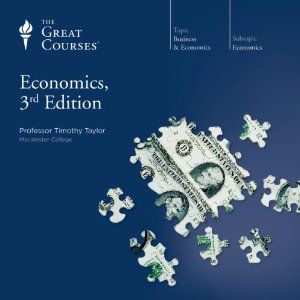
Economics, 3rd Edition, will help you think about and discuss these and other economic issues that affect you and the nation every day—interest rates, unemployment, personal investing, budget deficits, globalization, and many more—with a greater level of knowledge and sophistication.
Master the Basics of Economics
These 36 lectures do not require any special or advanced knowledge of mathematics. Instead, you will learn economics through intuitive explanations presented in plain English by an instructor who has received teaching awards at Stanford and the University of Minnesota. Professor Timothy Taylor’s first 18 lectures focus on “microeconomics,” which examines economics “from the bottom up.” You will explore the behavior of individuals, households, and firms, as well as their interactions in markets for goods, labor, and saving and investment. Topics in microeconomics include:
How do supply and demand function in the free market to determine the prices of goods we purchase and the salaries we earn? How are interest rates established, and what impact do they have on various decisions we make, such as selecting a house to buy? How do businesses compete with each other? What is a natural monopoly? What role does the government play in fostering and regulating competition? Additionally, we define “public goods”—such as national defense and education—that benefit all members of society, whether or not they contribute to their provision. The challenge of motivating citizens to support the production of public goods can be illustrated through a game theory problem known as the prisoner’s dilemma.
The second half of the course focuses on “macroeconomics,” which involves analyzing the economy from a broader perspective. Here, you will explore the factors that allow economists to assess the economy on both national and global scales. Key macroeconomic issues include:
– Common methods of government taxation and spending, and how these actions influence total demand and supply in our economy.
– The relationship between employment and inflation, including the differing viewpoints on this issue presented by the two primary schools of economic thought: Keynesians and neoclassicists.
– International economics, including arguments for and against international trade, how exchange rates are determined, and what they signify for individuals and the economy at large. You will also investigate future prospects for the global economy, identifying which nations are likely to thrive and which may struggle.
Throughout this course, Professor Taylor assists you in applying your knowledge to many of today’s most frequently discussed and often misunderstood issues. Is the global economy truly borderless, and does globalization lead to job loss for American workers? Why do the markets for car and health insurance often appear so expensive and contentious? What are our prospects for preventing the looming crises in Social Security and healthcare in the coming decades?
Learn to Think Like an Economist
One of the 20th century’s top economists, John Maynard Keynes, once said, “Economics is a method rather than a doctrine, an apparatus of the mind, a technique of thinking which helps its possessor to draw correct conclusions.”
You will learn that economics is essentially a way of thinking about big problems that face our society, and that economists sometimes think very differently about these issues than the rest of us do. You will practice thinking like an economist about a succession of topics that are in the news virtually every day, such as:
Is it realistic to view pollution as a moral wrong, as some environmentalists do, and try to eliminate it completely? Or can pollution actually have benefits? What would we have to give up if we tried to totally eradicate pollution?
How should the government decide whether or not to block a proposed corporate merger?
Should we control rents so that people can afford housing? Or should government subsidize low-income housing, or offer families rent vouchers? Which strategy would an economist favor? Which would a politician most likely choose?
In these lectures, you will appreciate the difficulties involved in formulating economic policies that are both effective and satisfying to everyone—consumers and businesses, Republicans and Democrats, rich and poor.
Economics Everywhere: From Cowrie Shells to Edison, from Mohair to Mickey Mouse
Economics isn’t just about numbers: It’s about politics, psychology, history, inventions, and countless other aspects of human endeavor. As a result, it never lacks for interesting, surprising, or amusing content. The following are a few of many examples:
Thomas Edison’s first invention was an automatic vote-counting machine. But he found he couldn’t sell it, so he vowed only to make inventions people would buy.
The idea of using a “basket of goods” to measure inflation goes back a long time. During the Revolutionary War, Massachusetts paid its soldiers the amount of money that would buy the following basket of goods: 5 bushels of corn, 68 and four-sevenths pounds of beef, 10 pounds of wood, and 16 pounds of leather.
The first federal minimum wage law, passed in 1938, was intended to keep jobs in northern United States from flowing to the south, where wages were much lower. It intentionally put millions of low-skilled black workers in the south out of work.
The item that served as money over the broadest geographic area and the longest period of time was the cowrie shell. It was in use as early as 700 B.C. in China and was subsequently used in India, Africa, and southern Europe. It was an acceptable way to pay taxes in some African nations well into the 20th century.
The argument that a product should be protected against foreign imports because it is vital to national security is often abused. In the 1950s, the American mohair industry successfully argued for protection—which exists to this day—on the basis that military uniforms contained mohair and without support for the industry American soldiers risked going to battle naked.
In other lectures, you will learn how various ways to measure and analyze the economy were first developed—for example, how America’s first statistical definition of poverty was formulated by one person, Social Security Administration employee Mollie Orshansky, in the 1960s. Professor Taylor takes you through the intricacies of patents, copyrights, and product advertising, with examples ranging from America’s top corporations to Sonny Bono and Mickey Mouse. You will even see that economic analysis can be applied to behavior that doesn’t seem related to economics at all, such as why so many Americans don’t vote.
Be an Economics Conversation Starter. Or Stopper.
If you complete this course and devote some thought to its subject matter, you’ll be able to hold your own any time the discussion turns to economics, whether it’s at your office, in the news, or at the dinner table.
If you hear someone say, for example, “A tax on gas could be a good way of encouraging people to drive less,” you’ll be able to add, knowingly, “Perhaps, but of course, it all depends on the elasticity of demand for gasoline.”
“I should warn you though,” Professor Taylor says, from personal experience, “that comments like this can either lead to a really much more intelligent and informed conversation, or they can lead the conversation to an abrupt and uncomfortable halt.”
Course Lecture Titles
01 – How Economists Think
02 – Division of Labor
03 – Supply & Demand
04 – Price Floors & Ceilings
05 – Elasticity
06 – The Labor Market & Wages
07 – Financial Markets & Rates of Return
08 – Personal Investing
09 – From Perfect Competition to Monopoly
10 – Antitrust & Competition Policy
11 – Regulation & Deregulation
12 – Negative Externalities & the Environment
13 – Positive Externalities & Technology
14 – Public Goods
15 – Poverty & Welfare Programs
16 – Inequality
17 – Imperfect Information & Insurance
18 – Corporate & Political Governance
19 – Macroeconomics & GDP
20 – Economic Growth
21 – Unemployment
22 – Inflation
23 – The Balance of Trade
24 – Aggregate Supply & Aggregate Demand
25 – The Unemployment-Inflation Tradeoff
26 – Fiscal Policy & Budget Deficits
27 – Countercyclical Fiscal Policy
28 – Budget Deficits & National Saving
29 – Money & Banking
30 – The Federal Reserve & Its Powers
31 – The Conduct of Monetary Policy
32 – The Gains of International Trade
33 – The Debates Over Protectionism
34 – Exchange Rates
35 – International Financial Crashes
36 – A Global Economic Perspective
This is a manual-send
978-1598031287
36 lectures with guidebook
NOTE: This only consists of the The Great Courses: Economics 3rd Edition, in the MP3 format (audio book). No access codes or are included. THIS IS NOT AN IMMEDIATE DOWNLOAD. YOU WILL BE SENT THE EBOOK WITHIN 24 HOURS OF THE ORDER