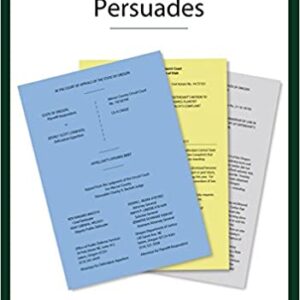




The revised edition of An Advocate Persuades, 2nd Edition, is organized into four distinct sections: (1) Introduction to Advocacy; (2) Developing Arguments from a Persuasive Perspective; (3) Crafting Persuasive Court Documents (applicable to both trial and appellate contexts); and (4) Oral Argument (covering both trial and appellate settings). Furthermore, the book includes a more comprehensive appendix that outlines trial and appellate litigation in civil and criminal matters, features annotated trial and appellate briefs, and provides guidance for moot court competitions.
The first section, Introduction to Advocacy, lays the groundwork by discussing the essence of persuasion and the fundamental ethical principles that advocates must adhere to.
The second section delves into the core of persuasive advocacy, emphasizing the creation of convincing arguments. It presents straightforward, step-by-step guidance that students can utilize when drafting either a trial motion or an appellate brief. This guidance is divided into five chapters: Chapter 3, Organizing Claims and Arguments; Chapter 4, Themes for Persuasive Arguments; Chapter 5, Drafting Persuasive Arguments; Chapter 6, Refining Persuasive Arguments; and Chapter 7, Editing Persuasive Arguments. These chapters have undergone considerable revisions to enhance clarity and practicality, featuring lists, checklists, visuals, and contemporary annotated examples to reinforce students’ grasp of the discussed concepts and theories.
The third section, Crafting Persuasive Court Documents, outlines the various court filings through which attorneys communicate their persuasive arguments. It begins with Chapter 8, Trial Motions & Motion Practice, focusing on practical trial courtroom motions and supportive writings. Chapter 9, Appellate Briefs & Appellate Practice, familiarizes readers with appellate courts by detailing the appellate process, its key players, standards of review, and how to compose different parts of an appellate brief. Lastly, Chapter 10, Statements of Fact and of the Case, explains how to formulate a compelling summary of facts, including which facts to highlight and how to showcase them favorably for the client’s benefit. Each chapter includes various annotated examples to illustrate both effective and ineffective strategies.
The fourth section, Oral Argument, has been organized into five parts aimed at clarifying the oral argument process. These segments give students the systematic support necessary for presentations in trial or appellate courts. The five parts include (1) The Purpose of Oral Argument; (2) Preparing for Oral Argument; (3) Presenting Oral Argument; (4) Trial Courts vs. Appellate Courts; and (5) Remote Oral Arguments. The newly added fifth part offers students guidance and practical tips for delivering oral arguments remotely.
With the release of the second edition of An Advocate Persuades, the goal is to provide clear and structured instruction on every aspect of the persuasive writing and oral argument process, arranged in a sequence that reflects an advocate’s typical workflow. The ebook merges practical theory with illustrative examples to assist readers in applying their knowledge in real legal settings. Its straightforward guidance, informative visuals, and user-friendly format make it a valuable resource for both classroom students and practicing professionals. attorneys.
An Advocate Persuades 2E: 978-1531019105, 978-1531019112, 978-1531030469, 9781531019112PDF, 978-1531019112PDF,
We highly recommend using the free Calibre to view the AZW3 ebook like the publisher intended.
NOTE: This only consists of the eBook An Advocate Persuades 2nd Edition, in the original AZW3 format. A converted PDF is also included. No access codes are included.